Philadelphia's Live Hip-Hop Architects
When The Roots emerged from Philadelphia's underground scene in the late eighties, they carried instruments instead of turntables. Black Thought and Questlove anchored a crew that challenged hip-hop's production orthodoxy, proving that drums, bass, keyboards, and guitars could deliver grooves as hard as any sampler. Their approach wasn't novelty—it was necessity, born from musicians who understood jazz vocabulary as fluently as breakbeat science.
What began as street corner performances evolved into one of hip-hop's most respected institutional forces. The Roots built a catalogue that spans decades without creative compromise, balancing commercial accessibility with artistic ambition. Their position as the house band for The Tonight Show Starring Jimmy Fallon since 2014 might seem like settling into elder statesman status, but it represents something more complex: a group that redefined what hip-hop musicianship could mean while maintaining artistic credibility.
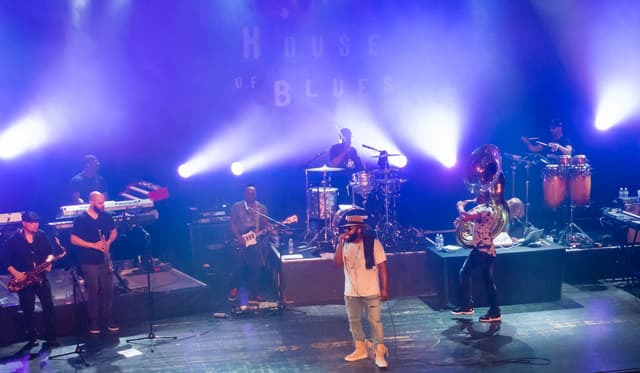
Their influence extends beyond their own recordings. The Roots legitimized live hip-hop performance as more than backing tracks and hype men. They demonstrated that a hip-hop group could function like a proper band—rehearsing arrangements, improvising within structure, and translating studio precision to stage energy. Philadelphia's musical heritage runs through their sound, connecting Philly soul's orchestral warmth to boom-bap's percussive attack.
The Architecture of Live Hip-Hop Production
The Roots construct hip-hop from the ground up, literally. Questlove's drumming provides the foundation—not programmed breaks but human pocket, the kind of timing variation that gives music breath. His approach borrows from J Dilla's swing and John Bonham's weight while maintaining hip-hop's rhythmic priorities. When paired with bassist Leonard Hubbard's (later Owen Biddle and Mark Kelley's) groove sensibility, the result feels like classic breakbeats reanimated through living musicians.
Black Thought's presence as an MC demands different analysis than most rappers. His technical precision—internal rhyme schemes, polysyllabic clusters, thematic consistency—places him among hip-hop's elite lyricists, yet his delivery never prioritizes complexity over clarity. He writes like a novelist and raps like a prosecutor, building arguments across verses rather than chasing punchline density. His voice carries Philadelphia's working-class grit without regional accent exaggeration.
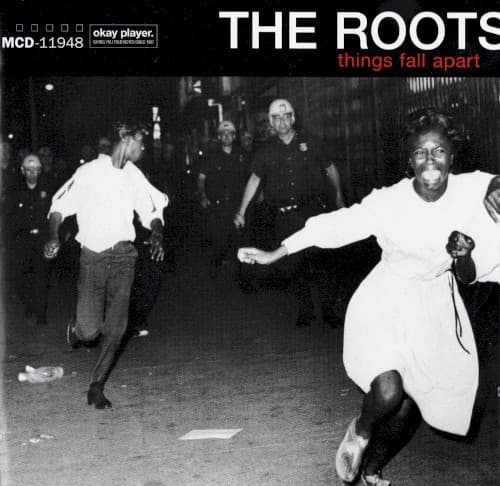
The group's sonic palette expanded across their catalogue. Early work leaned on jazz samples and live interpretation of classic breaks. By Things Fall Apart, they had integrated neo-soul textures, Fender Rhodes warmth, and symphonic arrangements without abandoning hip-hop's fundamental structures. Later projects incorporated rock dynamics, electronic processing, and guest production that challenged their instrumental identity. Their collaborative work with singers—Erykah Badu, Cody ChesnuTT, John Legend before fame—created a blueprint for live hip-hop's intersection with soul music that dozens of artists would follow.
From Street Corners to Tonight Show Permanence
The Roots formed in 1987 when Tariq Trotter (Black Thought) and Ahmir Thompson (Questlove) met at Philadelphia's High School for Creative and Performing Arts. Their early performances happened on South Street corners, building crowds through raw musicianship rather than mixtape buzz. This street-level apprenticeship shaped their understanding of audience dynamics—how to hold attention across a full set, how to translate energy without relying on studio trickery.
Their debut Organix (1993) arrived independently, documenting their live aesthetic before major label involvement. Do You Want More?!!!??! (1995) and Illadelph Halflife (1996) established their commercial presence, but Things Fall Apart (1999) represented their creative and commercial peak. The album moved 500,000 copies in its first year, driven by "You Got Me" featuring Erykah Badu—a radio single that didn't compromise their artistic identity. The project balanced boom-bap fundamentals with live instrumentation sophistication, proving mainstream acceptance didn't require sonic dilution.
Phrenology (2002) tested their audience's flexibility, incorporating rock aggression and electronic experimentation that alienated some core fans while expanding their creative vocabulary. The Tipping Point (2004) walked back some of that adventurousness, seeking commercial footing with mixed results. This period revealed the tension inherent in their approach: maintaining instrumental authenticity while navigating an industry increasingly focused on producer-driven beats and regional sound dominance.
Their partnership with Jimmy Fallon's late-night television franchise, starting with Late Night in 2009 and continuing through The Tonight Show transition in 2014, fundamentally altered their career trajectory. The position provided financial stability and cultural visibility, but required adapting their working method to nightly performance schedules. Albums became less frequent: undun (2011) arrived as a concept project, How I Got Over (2010) and ...And Then You Shoot Your Cousin (2014) explored darker thematic territory, while End Game (2024) marked their first studio album in over a decade.
Questlove's parallel career as a producer, author, and cultural commentator elevated The Roots' profile beyond music. His memoir Mo' Meta Blues and Oscar-winning documentary Summer of Soul positioned him as a historian and tastemaker, lending intellectual credibility to the group's legacy. Black Thought's guest verses and collaborative projects—particularly his acclaimed Streams of Thought series with producer 9th Wonder—reminded hip-hop purists of his elite technical abilities.
The Institution That Legitimized Live Hip-Hop
The Roots proved that hip-hop credibility and live instrumentation weren't mutually exclusive. Before their sustained success, live rap often meant diminished sound—backing tracks, reduced arrangements, energy compensating for missing sonic elements. They demonstrated that proper musicianship could enhance rather than dilute hip-hop's core elements. Every contemporary artist who tours with a full band, from Anderson .Paak to Noname, operates in territory The Roots mapped.
Their influence on conscious rap's commercial viability can't be overstated. Things Fall Apart arrived at a moment when mainstream hip-hop was fracturing between pop crossover and street authenticity. The Roots offered a third path: socially engaged content delivered through musical sophistication, accessible without pandering. They shared aesthetic DNA with A Tribe Called Quest and De La Soul's Native Tongues movement, but their instrumental approach created a distinct lane that dozens of artists—from Robert Glasper's jazz-rap fusion to The Internet's neo-soul experimentation—would later occupy.
Their Tonight Show residency represents an unprecedented institutional position for a hip-hop group. Critics debate whether it represents artistic compromise or strategic positioning, but the visibility has introduced multiple generations to hip-hop's possibilities. Questlove's role as musical director means hip-hop sensibility shapes how pop culture is presented nightly on network television—a form of cultural power that operates differently than chart dominance or streaming metrics. The Roots became hip-hop's establishment without losing respect from the underground that birthed them, a balance few artists achieve.